
Elmina Castle Royalties: Why the Record Supports Edina’s Claim
Elmina Castle Royalties: Why the Record Supports Edina’s Claim
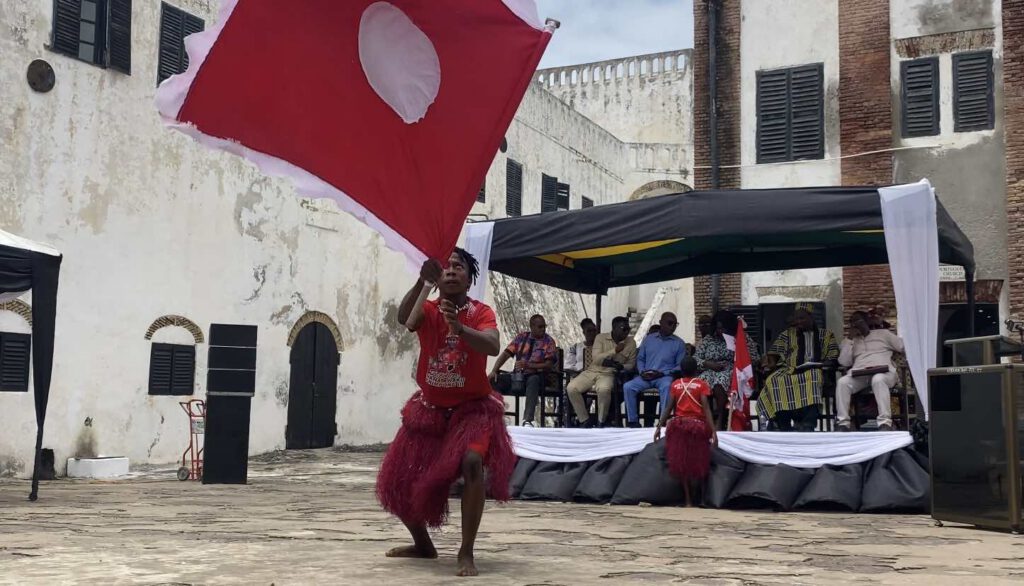
Two of the great oaths (Ntam) sworn in Edinaman go back to the events of 1873. That year Elmina’s king was sent into exile and the old town beside the castle was destroyed by British guns. On 10 August, at the 544th anniversary of Elmina Castle, the Edina Traditional Council renewed a demand that it says goes back to the same history. The council is asking for royalties from the castle that it says the Ministry of Tourism has not paid since 2009, and it has warned that it may perform traditional rites and invoke the gods of the Elmina land against the castle’s operations if the arrears remain unpaid. The demand was made in the castle courtyard during the anniversary commemoration, which also marked the relaunch of the Ghana Museums and Monuments Board’s Heritage Dialogue Series.
Oaths that keep 1873 present
Museum Elmina documents the history and living culture of the town, and for the museum the dispute cannot be understood apart from the two oaths. Nana Kobina Gyan Ne enisua, the tears of the king, recalls the arrest and exile of the Edinahene, Nana Kobina Gyan I. Edinaman Bo recalls the bombardment of Edina. In this tradition an oath binds those who swear it to the event it names, so these are not ceremonial phrases. Museum Elmina regards them as among the most significant heritage the town holds. More than 150 years on, they show that the community’s memory of 1873 is still active in its legal and spiritual life.
What the historical record shows
On 6 April 1872 the Dutch handed Elmina Castle over to the British. Nana Kobina Gyan I refused to recognise the transfer or to swear allegiance to the British Crown, and his grievance was recorded in words that survive today:
“On account of the hoisting of the English flag of the castle of Elmina the people have brought me great trouble. They have disgraced me.”
He was arrested, and on 30 April 1873 he was exiled to Sierra Leone without charge or trial. He stayed there for 21 years and returned to Elmina only in 1894, once the British authorities had agreed to it.
On 13 June 1873, about six weeks after he was sent away, British warships bombarded Elmina. The ancestral town beside the castle was destroyed, and for a time the old Edina ceased to exist.
The council’s claim
According to the council, the castle stands on land belonging to the Edina Traditional Area, and a long-standing arrangement entitles the traditional authority to 20 percent of the proceeds from managing it. The Paramount Chief of Edina, His Royal Majesty Nana Kodwo Conduah VI, directed his appeal to the Minister of Tourism, Culture and Creative Arts.
“I am calling on the Minister of Tourism, Hon. Abla Dzifa Gomashie, to address our concerns, or we will be compelled to carry out our threat by performing traditional rituals and invoking the gods of Elmina land against the operations of Elmina Castle in the coming days,” he said.
Nana Conduah VI stressed that the council had no wish to keep tourists away from the castle. He recalled that under the Kufuor administration, the late Minister of Tourism, Jake Obetsebi-Lamptey, released funds to the council after repeated appeals. Part of the money paid school fees for brilliant but needy students, and the rest supported community projects. The payments stopped when that administration left office and have not resumed. Responding on behalf of the Ghana Museums and Monuments Board, Dr Malik Mahmoud Saako, Head of the Board’s Museums Division, said the council’s message would be passed on to the Minister.
Museum Elmina’s position
Museum Elmina holds that Edina’s claim extends well beyond the terms of any management contract. A town that lost its ancestral settlement and saw its king exiled over events centred on this building is owed the royalties as a matter of historical justice. In the museum’s view, payment should not depend on the Paramount Chief raising the matter in public. The government and the Ministry of Tourism should settle it as part of their ordinary responsibilities.
The museum also makes a practical point from heritage management. Monuments are usually best cared for where the surrounding community has a real stake in them, and where a host community gets nothing from a site on its land, its interest in the site’s upkeep tends to decline. A fair share of the castle’s earnings would give Edina a direct reason to invest in its preservation, in addition to the historical ties it already has.
The wider discussion
The anniversary programme went beyond the royalty dispute. In his keynote address, the historian Professor Anthony Annan-Prah examined how the European forts and castles along the coast changed the communities around them, including their beliefs, the names of their towns and their patterns of trade. He urged Ghanaians to confront that history honestly and to forgive it without losing sight of its lessons.
Clifford Ashun, Central Regional Head of the Ghana Museums and Monuments Board, called for remembrance to become practical responsibility. He asked that sites such as Elmina Castle be preserved as places of learning for students of Edinaman Senior High School and for generations to come, an aim Museum Elmina shares.
Museum Elmina believes the matter is more likely to be settled through negotiation than ritual. The council has stated its case clearly, however, and it merits a considered response from the Ministry. The museum will continue to follow the dispute and to record it as part of the history of the town.