


Intangible Heritage
Collective Memory & Knowledge
How Edinaman remembers: the offices that hold the town's history, the forms in which it is recited, and the rules that govern who may speak it.
How Edinaman Remembers
In Edinaman, history is not housed in archives; it is lived. Our record is formally entrusted to living offices: encoded within sacred stools, preserved by family elders, and chronicled through the civic accounts of our Asafo companies. Long before ink met paper, Edinaman had already perfected a profound system of memory replete with its own designated keepers, formal occasions, and strict protocols governing the right to speak.
The Right to Speak
Historical recall here is an earned responsibility, not a mere talent. The right to recount the past must be formally granted by the state. A stool’s history belongs fundamentally to that stool and its servants. It is recited solely by those whose position mandates such knowledge.
Chief amongst these custodians are the Kyeamefo (linguists). Far more than traditional spokesmen, a Kyeame may serve the state, the ebusua (clan), or the Asafo companies. Each bears the staff of his specific office and guards the words entrusted to it. When he speaks, he ensures the office communicates with absolute propriety, carrying the full weight of its memory.
“This structured custodianship explains why an Asafo company, a family, and the Traditional Council might recount the same event differently without any version being false. Each simply testifies to the specific truth its office is authorised to tell.”
Similarly, household elders fiercely protect their genealogy. They will swiftly correct any younger relative who handles it carelessly.
During Edina Bronya, the town unveils a war drum captured from Fante forces during a historical siege on Elmina. Beaten during the Akete Akete rite, the drum serves as physical evidence, whilst the accompanying song provides the definitive historical account.
The Occasions of Remembrance
Crucially, this knowledge is never performed merely for entertainment. It is summoned precisely when required:
- When a stool is occupied.
- During a solemn burial.
- When the community convenes for Edina Bakatue or Edina Bronya.
- When a dispute demands that elders recite binding precedent.
The occasion itself forms part of the historical evidence. Words spoken at a royal installation carry an entirely different resonance at a funeral. Furthermore, certain sacred accounts are strictly forbidden from being voiced outside their appointed day.
The Dignity of Silence
A community that remembers deeply must also decide what it will not repeat. In Elmina, this judgement is both explicit and respected.
Certain narratives belong exclusively to specific offices and cannot be uttered by outsiders. Other histories are universally known yet deliberately left unspoken, as voicing them could fracture the peace between neighbours who still share the same soil.
A museum that views these silences merely as gaps to be filled profoundly misunderstands the culture it observes. Our curatorial duty is to document what the community permits to be recorded, leaving the ultimate judgement of silence to those who own the history.
Two Streams of History
Alongside this living, spoken archive sit physical, colonial documents: church registers, private family papers, and the vast Dutch, Portuguese, and British records. In these external archives, Elmina is often documented purely as an imperial business interest.
Museum Elmina
approaches these colonial archives through the rigorous research of our own historians. We place the written text beside the oral tradition, rather than above it.
THE FRICTION OF THE RECORD
Often, these two streams of memory disagree. This friction is itself highly informative, reminding us that each record was crafted for a vastly different purpose, perspective, and audience
A Vanishing Archive
Today, the custodians of our oral history are few, and they are not being replaced at the rate they are being lost. Appellations vanish when the elder who knows them passes away. The public act of libation survives, but the specialist texts that accompany it are quietly fading.
As modern schooling and shifting beliefs alter what is deemed vital to learn, our timeframe narrows. The purpose of this digital archival wing is not simply to describe the memory systems of Edinaman. Our mission is to actively record them whilst the voices that hold our truth are still here to guide us.
Image Archive
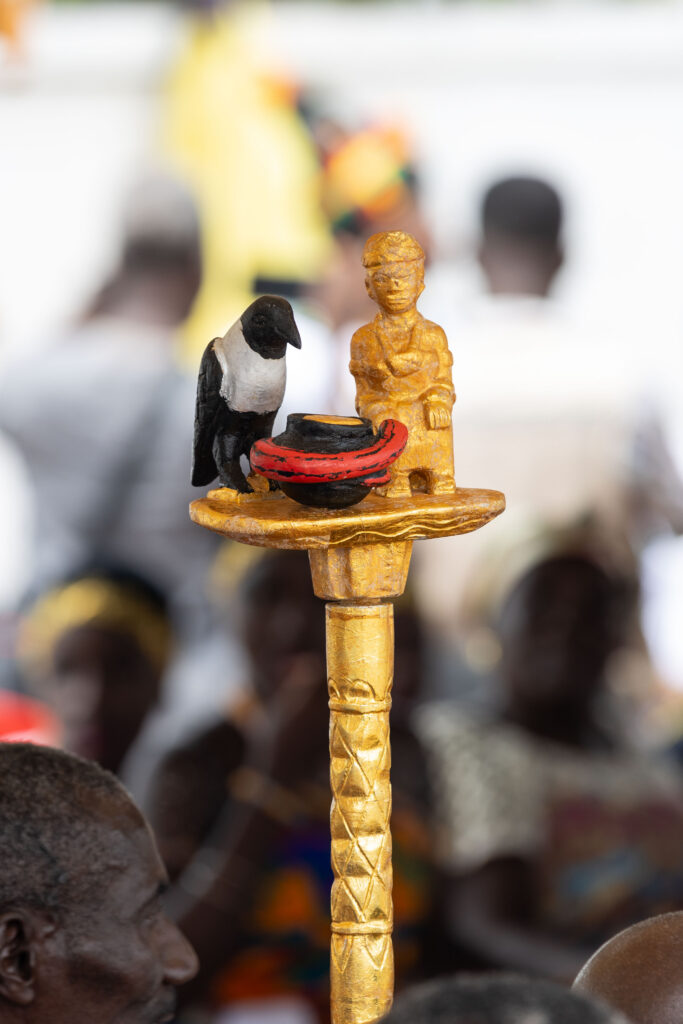
The crow of the Nsona Ebusua, borne beside the Obaapanyin, Senior Matriarch of the clan © Museum Elmina
Photographs © Museum Elmina. Reproduction or redistribution requires written permission.
© Museum Elmina
Collective Memory & Knowledge
Sources & Credits
How this knowledge was gathered
Written by Museum Elmina in Elmina, from the museum's own documentation of the town's institutions and from years of conversation with the holders of this knowledge, among them Prof. Anthony Annan-Prah and Ebow Dadzie. This page is an introduction. The detailed records, including the oaths, libation and appellations, are published as separate pages as each is documented with those who hold them.
Curated by Museum Elmina