

Intangible Heritage
Spiritual & Cosmological Systems
Seventy-seven gods, the ancestors, and Nyankopɔn above them: one order, held together by libation.
The Tripartite Cosmos
In common with the wider fabric of Akan spirituality, the people of Edinaman live within a meticulously ordered, three-tier cosmos: the Supreme Being, the deities of the middle realm, and the ancestors. Far from representing disjointed beliefs, this is the enduring reality that binds the society together in a singular, interconnected spiritual order that dictates daily life, law, and survival.
The Supreme Being: Nyankopɔn
At the zenith of this universe resides Nyankopɔn, the Supreme Being who occupies the celestial firmament. He is credited with the absolute creation of the heavens, the earth, and all living entities that abide within them.
The Middle Realm: The Seventy-Seven Deities
The terrestrial and civic landscape of Edinaman is animated by seventy-seven distinct deities, distributed across the capital of Elmina and its surrounding communities.
- Nana Kobina Benya: The sovereign leader of this local pantheon.
- Bosompo: The god of the sea, who governs the coastal waters.
- Asaase Efua: The goddess of the earth and land. Her name preserves the cultural reckoning of time: Efua denotes a female born on a Friday, the very day the earth is held sacred, forbidding agricultural disturbance.
THE SEVENTY-SEVENTH DEITY
Crucially, the King of Edinaman is himself counted as the seventy-seventh deity. By virtue of his sacred succession, he is held to be born of the gods.
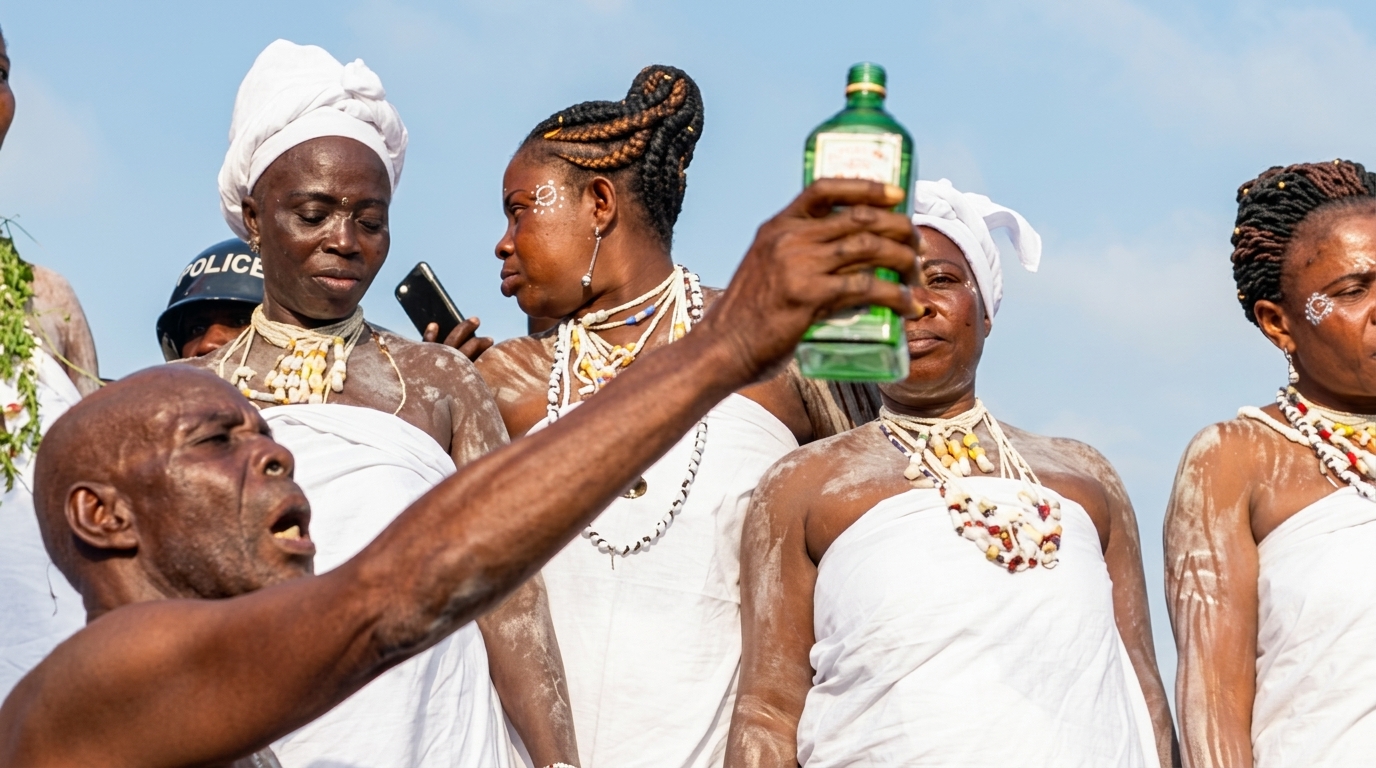
During spiritual or state processions, it is strictly forbidden to bypass the abode of a deity without rendering due reverence. Consequently, a royal procession departing the Anomansaman Ahenfie (the palace) halts at designated stations along its route to pour libation. Because every crossroads is believed to house a deity, these junctions serve as mandatory ritual stops to pacify the unseen inhabitants of the town.
Celestial and Marine Observances
The fishermen of Edinaman maintain rigorous, practical observances towards Bosompo, demonstrating how spiritual reverence merges seamlessly with generations of empirical maritime knowledge:
- The Law of Tuesday: No fishing canoe may enter the ocean on a Tuesday. This day belongs exclusively to the sea god, who is believed to spend it undisturbed with his children, the fish. There is no beating of drums on this day as a sign of reverence to the gods.
- The Governance of the Moon: Nocturnal fishing ceases when the moon is out. The intense celestial light illuminating the ocean’s surface is understood to disorient the fish, concealing them. Conversely, on moonless nights, the fish rise to the surface, revealed to the fishermen by their own natural bioluminescent glitter on the water.
Signs within the heavens similarly dictate the civic calendar. Prior to the sacred rites of the Edina Bakatue festival, the sky reveals
Abrewa atɔnsu “the old lady has fallen into the water” the appearance of a comet or shooting star.
This celestial event summons the traditional priesthood to invoke the heavens, a ritual climaxing in a heavy downpour of rain that officially heralds the commencement of the festival season.
The Ancestral Realm
Within this framework, the ancestors are not worshipped, but deeply revered. Having crossed the threshold into the spiritual realm, they possess a clarity of sight that extends far beyond the physical world. In traditional prayers, the ancestors are invoked as essential intermediaries, uniquely positioned to guide the living and carry human petitions directly to the Creator.
One Living Order
The ritual thread that binds this tripartite cosmos together is the pouring of libation. Through the spoken word, the petitions of the living are presented before the deities of the sea, the land, and the town, whilst the ancestors elevate these messages to Nyankopɔn. In Edinaman, the gods inhabit the physical landscape of the state, and the people live natively amongst them.
While Christianity has been present along this coast since the arrival of Europeans and is widely practised today, it has not displaced this indigenous cosmology. Many who worship within Christian churches simultaneously uphold the traditional observances owed to the deities and the ancestors, finding no moral or intellectual contradiction in maintaining dual streams of faith.
Knowledge shared by Prof. Anthony Annan-Prah and Ebo Dadzie.
Image Archive
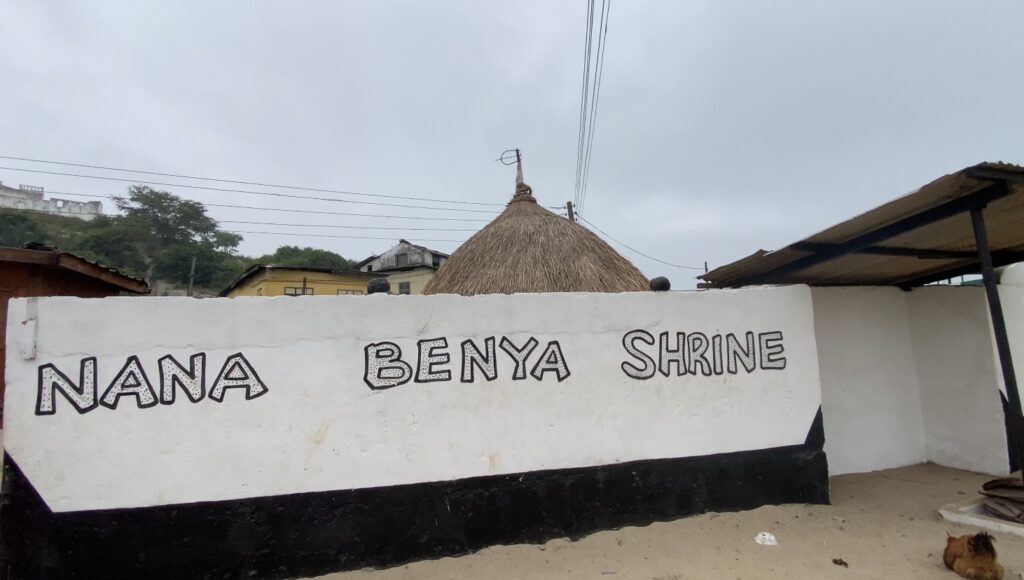
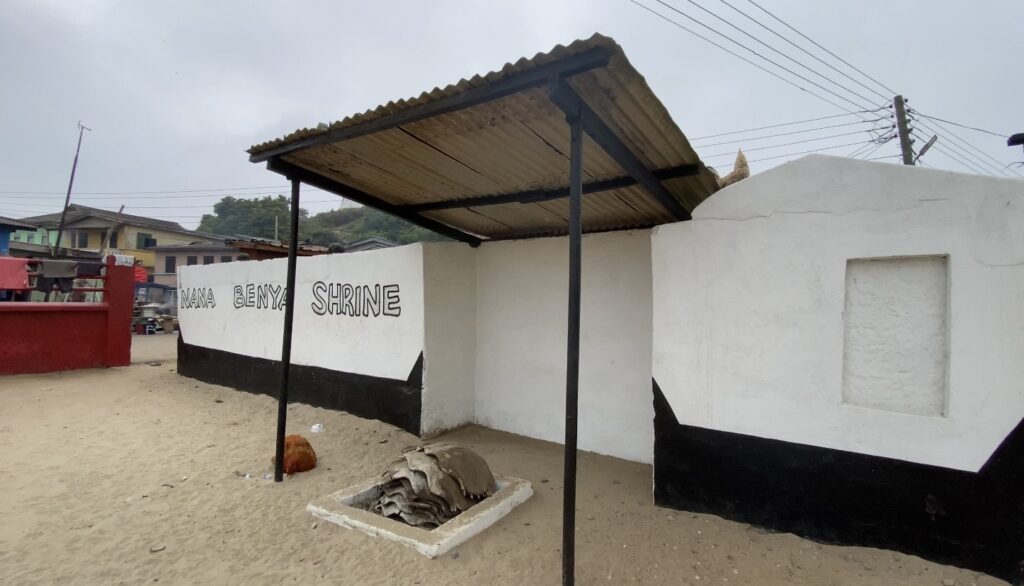
Nana Kobina Benya Shrine © Museum Elmina
Photographs © Museum Elmina. Reproduction or redistribution requires written permission.
© Museum Elmina
Spiritual & Cosmological Systems
Sources & Credits
Knowledge holders
-
Prof. Anthony Annan-Prah
-
Ebo Dadzie
How this knowledge was gathered
Oral history interviews recorded on video in Elmina, transcribed and curated by Museum Elmina for this page.
Recorded: August 2026, Elmina (on several days)
Curated by Museum Elmina