


Tangible Heritage
The Ancestral Home
The old town of Elmina stood on the peninsula until 13 June 1873. This is the ground, what was on it, and why it was never rebuilt.
The Old Town of Elmina
The Peninsular Ground, the 1873 Destruction, and the Geometry of Absence
Until 13 June 1873, the ancestral heart of Edinaman occupied the narrow spit of land bounded by the Benya Lagoon and the Atlantic Ocean. This was once the most densely settled urban centre on the Gold Coast: an ancient civic core populated by merchants, fishermen, guild craftsmen, and Euro-African families whose homes had stood upon the same ancestral plots for centuries. On that day, British naval artillery reduced the town to rubble. The wreckage was systematically cleared to create an open military parade ground, and surviving residents were prohibited from returning under imperial decree. This exhibition examines what stood upon that soil, the political manoeuvres that led to its destruction, and the customary memory that endures in its absence.
Anomansa
Long prior to European maritime contact, the settlement was established by Kwaa Amankwaa under the name Anomansa. It flourished as a sovereign Fante polity bound to the Benya Lagoon by sacred covenant, sustained by salt production, marine fisheries, and extensive mercantile routes carrying gold and forest commodities from the Akan interior to the Atlantic littoral. The peninsula provided exceptional natural anchorage: sheltered lagoon waters to the north and the open ocean to the south. The visual materials exhibited in this section comprise curatorial reconstructions synthesised from cartographic evidence, topographic surveys, and local oral tradition. They serve as interpretive studies of the urban form and landscape rather than literal architectural documentation of individual edifices.
The Peninsular Townscape
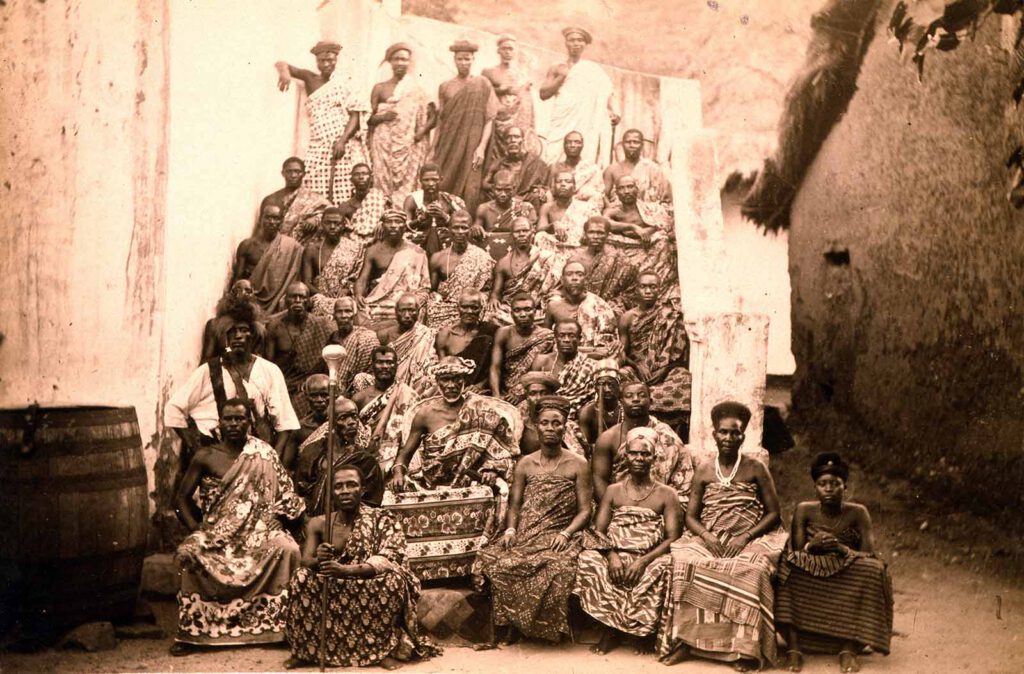
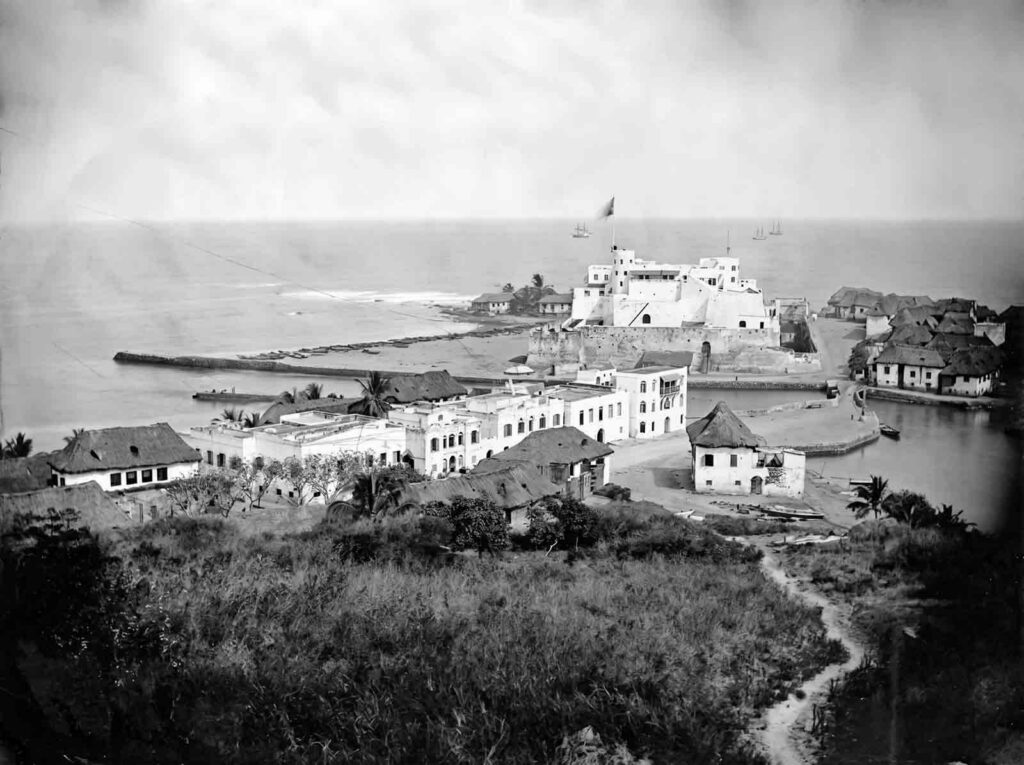
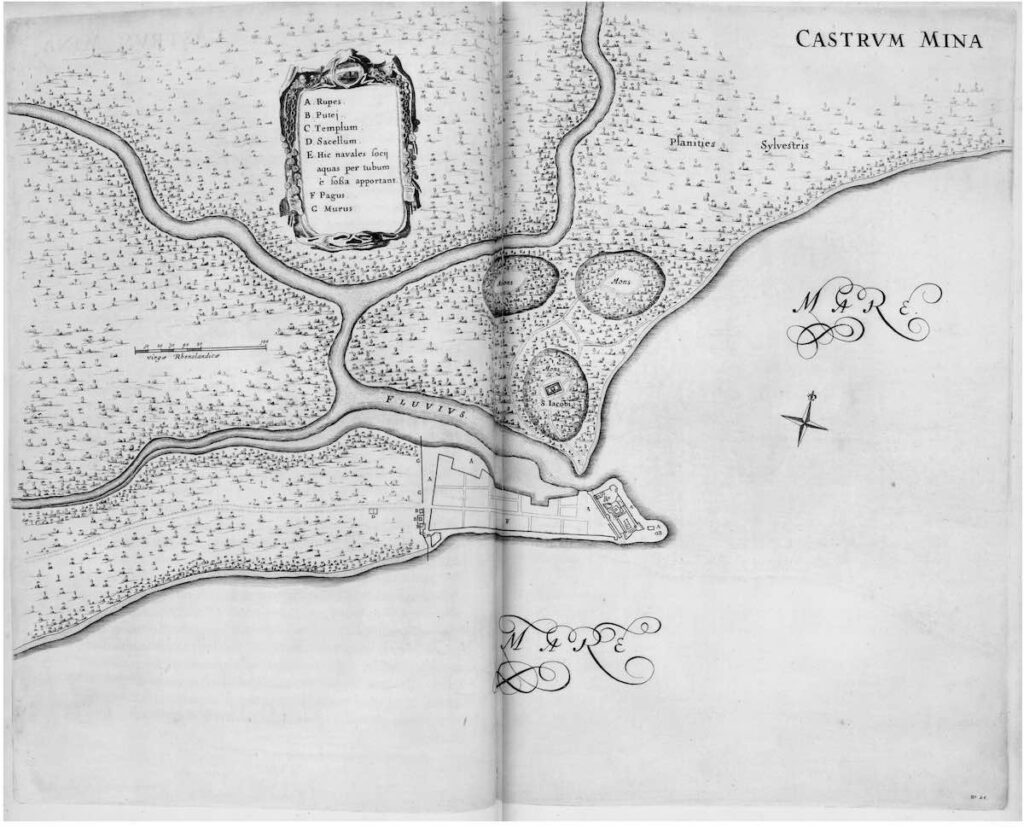
By the mid-nineteenth century, Elmina supported a population exceeding twelve thousand inhabitants. It was a cosmopolitan maritime centre of indigenous lineages, established Euro-African dynasties formed across generations of European and local unions, active Asafo military companies, and commercial houses maintaining direct correspondence with mercantile firms in Rotterdam. Comparative historical cartography traces the urban evolution of the peninsula across four centuries. The panoramic depictions of the settlement from circa 1870 represent the final visual records of the town before its complete eradication.
The Dutch Withdrawal and Imperial Cession
Following the transatlantic abolition of the slave trade, the administrative maintenance of the Gold Coast forts ceased to yield a commercial profit for the Dutch colonial treasury. An attempt in 1867 to rationalise territorial holdings through an exchange of forts with Britain collapsed into diplomatic crisis, provoking armed conflict with the Fante Confederation and placing Elmina under protracted siege. By 1870, the Netherlands sought an orderly exit, while the British colonial office sought unified territorial control over the littoral. The transfer was formally ratified between the two imperial crowns in the Anglo-Dutch Treaties of 1870 and 1871, taking effect on 6 April 1872.
Neither colonial administration consulted the Edina state as a sovereign party to the negotiations. This unilateral cession provoked immediate diplomatic resistance on two fronts. The paramount government of Elmina, led by Nana Kobina Gyan I, maintained that Elmina had never constituted Dutch territory to be transferred: the Dutch presence at St George’s Castle had existed solely on customary leasehold terms, and the town owed fealty to no foreign crown. Concurrently, the Asantehene, Kofi Karikari, challenged the treaty on the premise that Elmina stood in tributary alliance with Kumasi. For generations, the Dutch administration had rendered an annual customary stipend to Kumasi in connection with Elmina, a payment the British immediately terminated upon occupation. The Edina state maintained that this financial arrangement existed solely between the Asante court and the Dutch Company, bearing no prejudice upon Elmina’s domestic sovereignty. For Asante, Elmina represented its primary remaining unhindered corridor to the sea.
The Rejected Oath of Allegiance
On 12 March 1873, the governing leadership of Edinaman was summoned to the Officers’ Mess at Elmina Castle and instructed to swear formal fealty to the British Crown. Nana Kobina Gyan I, Edinamanhen, resolutely refused, supported by state councillors Tando Mensa and Kwamina Ekum. Grounding his defiance on the principle that the Dutch had held no sovereign property in the town to surrender, the King was placed under immediate arrest and transported under armed guard by sea to Cape Coast Castle.
The Asante Northern Campaign
In January 1873, an Asante military expedition crossed the Pra River into the British-protected territory. The ensuing campaign spanned several months. On 5 June, Asante forces defeated the allied Fante army at Jukwa, driving thousands of displaced persons into Cape Coast. The British military garrison on the coast was understrength, debilitated by endemic fever, and incapable of mounting an immediate field offensive.
Within this strategic crisis, Elmina’s geopolitical allegiance proved pivotal. Colonial intelligence, heavily reliant on informants within the township, concluded that the town would rise in armed alliance with the Asante advance once the northern forces reached the coast. With Nana Kobina Gyan I already imprisoned at Cape Coast for refusing the oath, the British command chose not to test the town’s intentions through diplomacy.
Edena Man Bɔ: The Bombardment
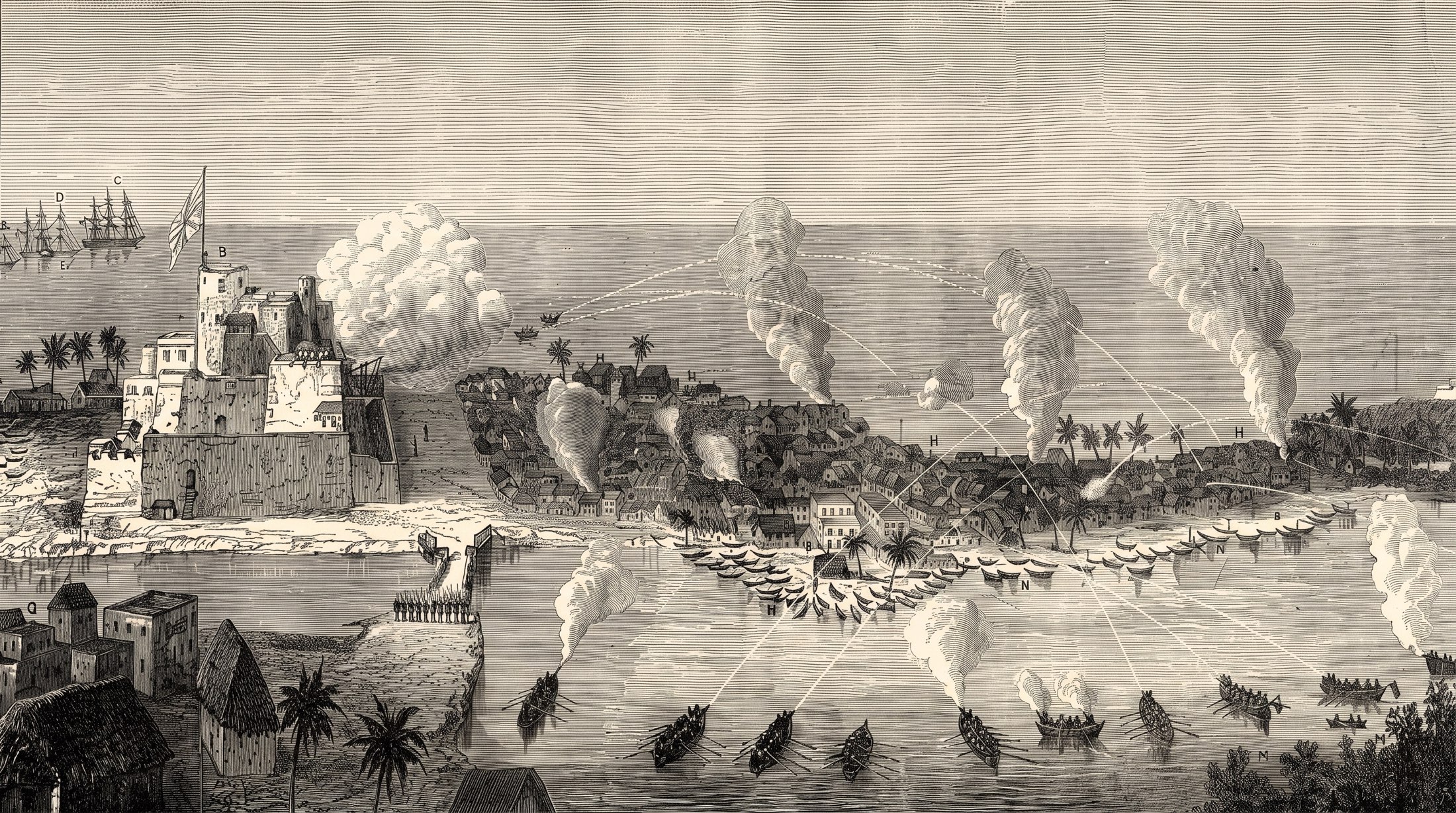
On 13 June 1873, eight days after the engagement at Jukwa, Royal Navy warships opened fire upon the peninsula from the Gulf of Guinea, supported by armed launches deployed within the Benya Lagoon. Within hours, the ancestral town and its centuries-old architecture were entirely levelled by explosive ordnance and resulting firestorms. The artistic illustration displayed here, published in the Illustrated London News on 26 July 1873, represents the sole widely circulated graphic record of the attack. It reflects how imperial military violence was framed for metropolitan British consumption, rather than documenting the humanitarian catastrophe inflicted upon the twelve thousand residents displaced from the peninsula.
The wider Anglo-Asante War continued long after the fall of the town. Sir Garnet Wolseley disembarked in October 1873, capturing and burning Kumasi in February 1874. Under the subsequent Treaty of Fomena in March 1874, Asante was compelled to renounce all customary claims to Elmina. By that date, the town over which the dispute had been waged had already ceased to exist.
The Demarcation of Absence
The physical devastation of 13 June 1873 permanently altered the human geography of the coast. Imperial engineers levelled the smouldering ruins, cleared the ground into an open military parade plain, and enacted strict customary prohibitions against any indigenous resettlement upon the peninsula. A prosperous maritime settlement of more than twelve thousand people was dispersed; over half the population lost their ancestral patrimony in a single morning. Displaced families inhabited temporary refuge settlements in the surrounding agricultural hinterland for years, while established Euro-African merchant lineages migrated permanently to Cape Coast.
When residents gradually returned in the late 1870s and 1880s, the prohibition against peninsular habitation remained strictly enforced by colonial authorities. Deprived of their ancestral ground, the community relocated to the northern mainland on the opposing bank of the Benya Lagoon, creating the bifurcated civic layout that defines contemporary Elmina. Today, the peninsular site lies within the UNESCO World Heritage precinct that encompasses St George’s Castle and Fort St Jago. It remains unbuilt: a cleared expanse of grass, gravel, and civic parking that covers the foundations of the ancient town.
Exile and Restoration
Following his arrest, Nana Kobina Gyan I was deported to Freetown, Sierra Leone, on 24 June 1873, where he remained in political exile for twenty-one years. British colonial authorities initially offered his repatriation on the condition that he return stripped of his royal status as a private citizen. The King rejected the compromise, choosing to remain in exile for an additional year until the imperial administration conceded to his return as crowned monarch. On 17 May 1894, assisted by District Commissioner Hendrik Vroom, Nana Kobina Gyan I landed once more at Elmina and was reaffirmed as Edinamanhen in a grand public re-installation. He passed away on 12 March 1896, precisely twenty-three years to the day after his initial refusal of the imperial oath.
The Oath of Catastrophe
In customary constitutional law, the destruction of 13 June 1873 was consecrated as Edena Man bɔ (The Fall of the Edina State), one of the four sovereign Oman Ntam. These sacred oaths bind contested legal disputes to the collective invocation of an unendurable historical disaster, immediately commanding the matter to formal judicial settlement before the traditional council. Having preserved the event through sacred jurisprudence rather than Western archival methods, the state maintains the oath in active legal authority to this day.
The Archival Mandate
For more than a century, the events of 13 June 1873 were largely excised from national historiography. In British military memoirs of the Ashanti Campaigns, the bombardment was relegated to a passing footnote regarding a strategic precaution against an uncooperative port, while mainstream Ghanaian textbooks routinely bypassed its regional impact. Within Elmina, memory of the catastrophe endured through the invocation of the Oman Ntam and oral testimonies transmitted across generations. However, as the generational chain thins, fewer voices remain to recall the community that once thrived between the castle and the lagoon. The peninsular ground remains silent, offering no physical sign of the urban life buried beneath it. To document this trauma and reconstruct its living memory is the foundational curatorial responsibility of this museum.
Image Archive
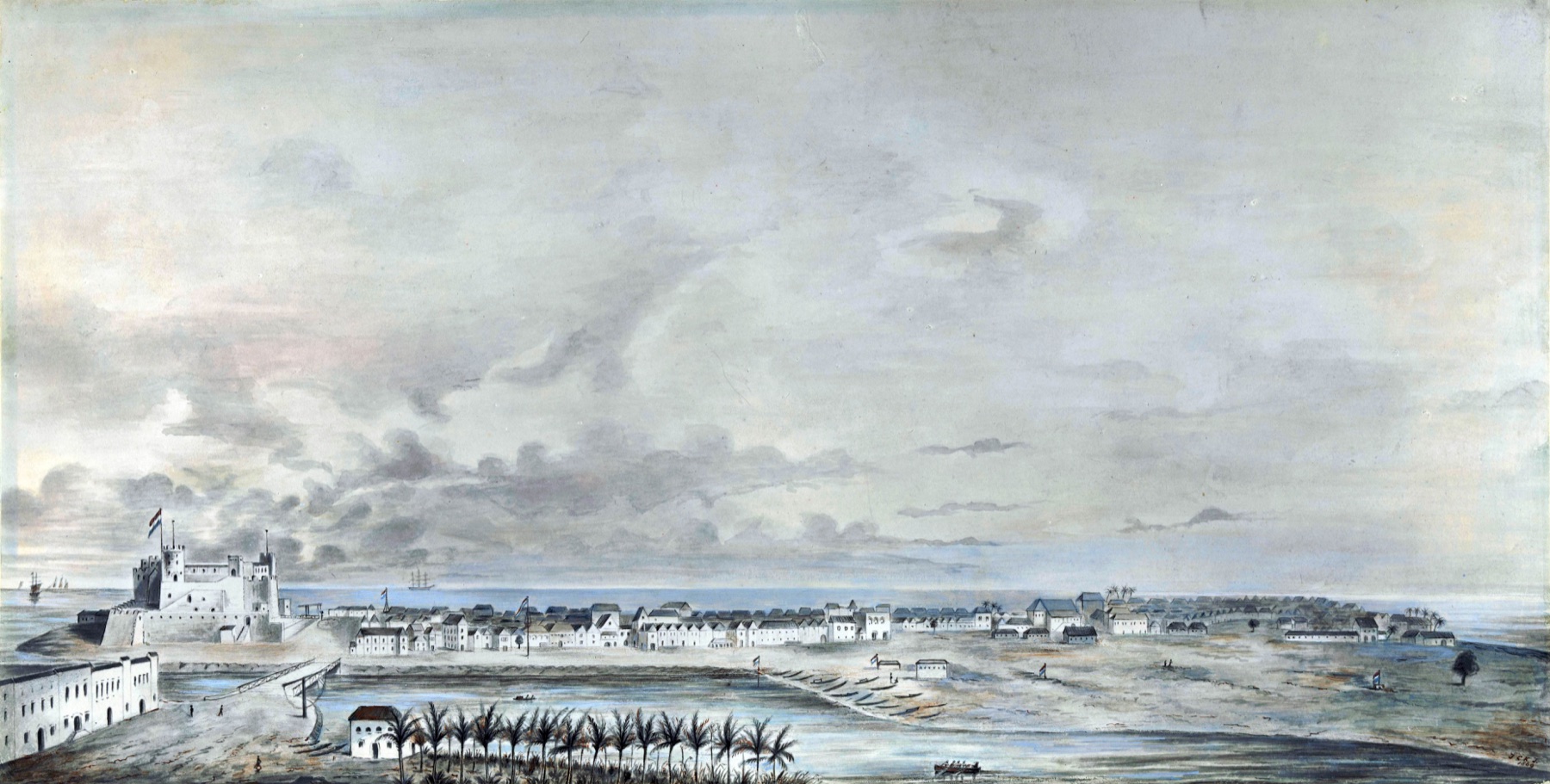


Elmina from Fort St Jago, about 1870. The castle at the left under the Dutch flag, the old town along the peninsula between lagoon and sea. © Museum Elmina
Photographs © Museum Elmina. Reproduction or redistribution requires written permission.
© Museum Elmina
The Ancestral Home
Sources & Credits
How this knowledge was gathered
Written by Museum Elmina in Elmina, from the museum's own documentation of the town and the peninsula, from the record kept by the Edina Traditional Council, and from colonial correspondence and contemporary printing held elsewhere. Where the museum's dates differ from earlier printed accounts, the museum's are given and the difference is stated.
Curated by Museum Elmina