


Tangible Heritage
Fort St. Jago
Fort St. Jago, historically Fort São Tiago da Mina, has stood watch over Elmina Castle and the Atlantic since the 1660s.
Perched on a high hill directly opposite Elmina Castle in Elmina, Fort St. Jago, also known historically as Fort Conraadsburg or Fort São Tiago da Mina, stands as a testament to a pivotal lesson in military strategy. Its location on Jago Hill was no accident: the hill’s commanding elevation offered a sweeping, unobstructed view of the castle, the town of Elmina, and the vast Atlantic Ocean, instantly making it the most valuable piece of terrain along this stretch of the Gold Coast.
Before the Fort: The Portuguese Chapel of São Tiago (São Jago)
Before the Dutch set foot on the hill, the Portuguese had already recognised its importance. In the early 1500s, after securing permission from a local chief, the Portuguese erected a small earthen chapel on the hill dedicated to their patron Saint Jago (Saint James). This building served a dual purpose: a place of Catholic worship for the garrison and, due to its elevation, a lookout post and fortified observation point overseeing the approaches to the sea and the castle below.
The Battle of Elmina (1637): How the Hill Changed Everything
The turning point came in 1637 during the Dutch Portuguese War. The Dutch West India Company, determined to break Portugal’s powerful hold on the Gold Coast, committed a formidable force of nine ships, 500 sailors, and 800 soldiers to the operation. Commanded by Colonel Hans Coine, the Dutch force recognised immediately that the key to capturing the formidable St. George of Elmina Castle was not a direct assault, but the occupation of St. Jago Hill.
Initially, 1,000 Portuguese allied native warriors guarded the base of the hill, forcing the Dutch into a fierce fight. After heavy losses, the Dutch secured the high ground and hauled heavy artillery up its slopes. For two days, they bombarded the castle from above, exposing its weakest inland defences. The Portuguese governor, Dom Francisco de Sotomaior, who had famously repelled a Dutch attack in 1625, now found his position untenable. He requested a three day truce, but Hans Coine refused, as Dutch provisions would only last another day. With his supply lines cut and his garrison taking heavy punishment, Governor Sotomaior was forced to surrender. The Dutch took control of Elmina Castle on 29 August 1637. The message of Jago Hill was now brutally clear: control the high ground, or lose your castle.
Construction & Strategic Purpose
Having learned this hard won lesson from their Portuguese predecessors, the Dutch knew they could not leave the hill undefended. Immediately after their victory in 1637, they initially built temporary earthen fortifications on the site of the destroyed Portuguese chapel, converting it into a residential building and watchtower. The main stone fort, named Coenraadsburg after Albert Coenraetsz. Burgh, a prominent director of the Dutch West India Company, was built by Director General J. Valckenburgh in the 1660s.
Fort St. Jago was a purely military structure. Unlike many other coastal trading posts, it contained no commercial warehouses. Its sole purpose was the defence of Elmina Castle. Dutch engineers oriented its strongest inland facing bastions to counter the most likely source of a future assault, protecting St. George’s Castle from an attack from the hill ever again.
Architectural Features
The fort’s architecture is a classic example of seventeenth century European military engineering adapted to the tropics. It was built from local sandstone, which was robust enough to withstand artillery fire. The design is stark and functional: a central watchtower, later reduced in height in the twentieth century, surrounded by defensive walls anchored by four corner bastions. These bastions were designed not for ornamentation, but for strategic fire, allowing the garrison to sweep the entire landward approach. Over the years, the fort went through several phases. British alterations after 1872 added a second floor to the main building to accommodate permanent habitation, and twentieth century renovations roofed the open bastions, softening its purely military silhouette.
Later Uses and Legacy
True to its military design, the fort served as a fortified barracks, a prison for European convicts, and a disciplinary institution for errant Dutch officers. After the British assumed control of the Dutch Gold Coast in 1872, it gradually took on more civilian roles, serving at various points as a hospital, prison, rest house, and finally as an inn and restaurant in more recent times.
UNESCO World Heritage Status
In 1979, UNESCO inscribed Fort St. Jago on the World Heritage List as part of the serial property “Forts and Castles, Volta, Greater Accra, Central and Western Regions” (ID 34-005). It is recognised for its outstanding universal value as a testimony to European colonial expansion and the economic and historical currents of the Atlantic world. From its Portuguese origins as a chapel to its strategic role in the Dutch capture of Elmina Castle, Fort St. Jago remains one of the most important military structures of the Gold Coast, a silent sentinel that watched over one of history’s most important strategic crossroads.
Image Archive


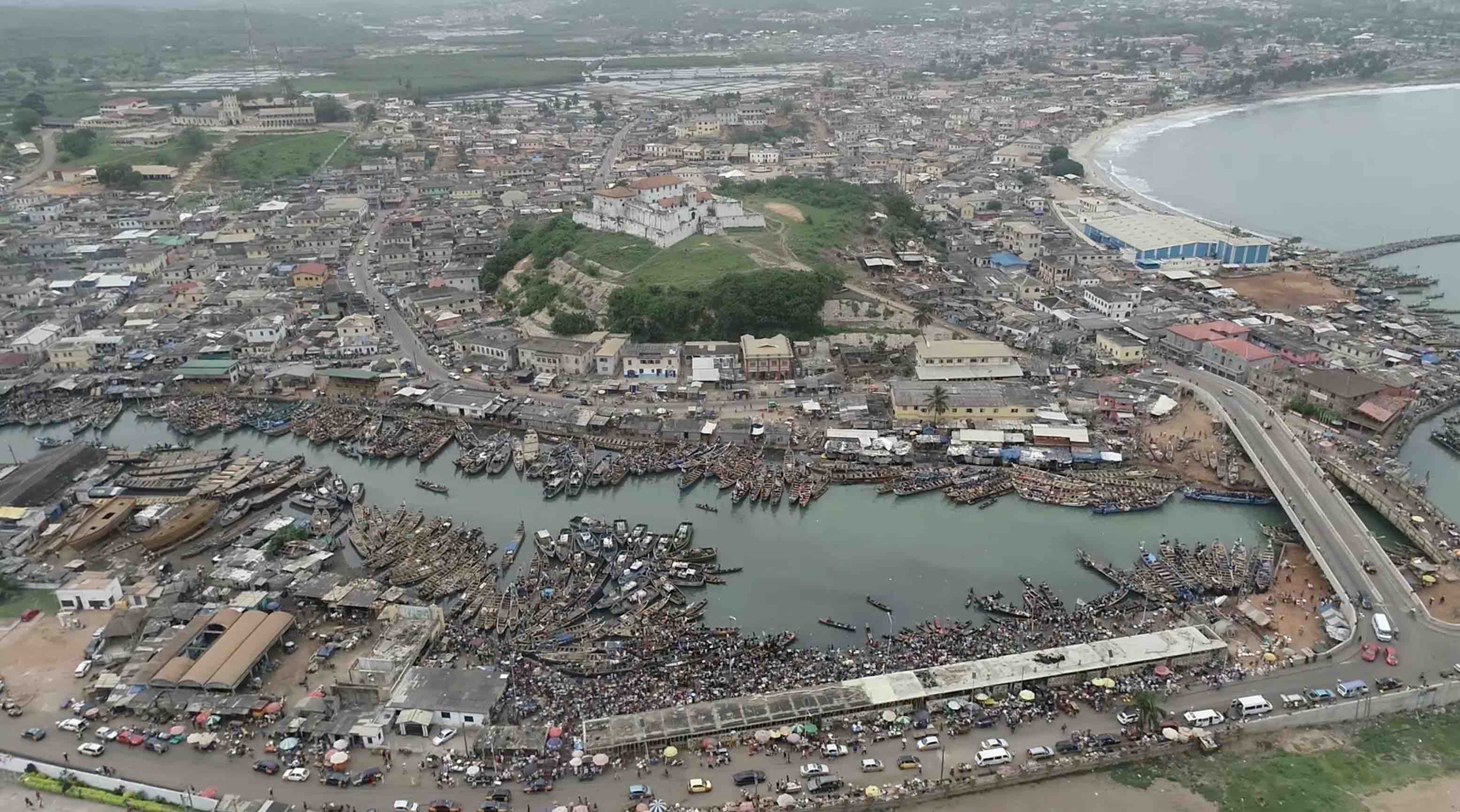

Fort Jago Front View © Museum Elmina
Photographs © Museum Elmina. Reproduction or redistribution requires written permission.
Documentary
© Museum Elmina