


Intangible Heritage
Traditional Authority & Governance
Led by the Edinamanhen and the Asafo Besoun, the Edina Traditional Council remains the working government of Edinaman.
The Extent of Edinaman
Edinaman encompasses far more than the municipality of Elmina alone. The traditional state comprises twenty-five distinct communities, bounded to the east by the Sweet River, where Iture marks the border. From this coastal frontier, the territory extends west to Dutch Komenda and stretches inland across a northern hinterland that includes settlements such as Atonkwa, Simiw, Ntranoa, Nkontrodo, and Ankaful. Sovereign authority is held across this entire geographic expanse, binding all twenty-five constituent communities to the governance structures and sacred rites of the paramount state.
The Council and Its Offices
Rooted in customary constitutional order, the Edina Traditional Council is governed by the Edinamanhen, the Paramount King of the state. He is counselled and sustained by the Asafo Besoun, the Seven Warrior Groups, whose members consist predominantly of Asafo captains alongside selected Ebusuapanyin, the heads of constituent matrilineal lineages. Beyond this executive core convenes a broader parliamentary body comprising the Asafo Besoun, the Ngwadohen, and appointed civic elders of distinguished standing. The royal cabinet is completed by the traditional divisional commanders: the Tufohen, Tsidomhen, Ninfahen, Benkumhen, and Gyaasihen, unified under the leadership of the Kousonhen, the supreme head of all Asafo companies.
Procedure to Kingship
Custodianship of the Edinaman paramount stool, both the supreme seat and ancestral shrine of royal office, is entrusted to Eyampa Asafo Number 7. In traditional Akan constitutional order, succession to the stool is strictly matrilineal (ebusua), passing through maternal lineages. In Edinaman, the right to put forward an eligible royal candidate belongs exclusively to two royal houses: the Anona and Ensona dynasties, with ascension alternating between them.
However, Edinaman marks a historic departure from pure matrilineal descent. During the late seventeenth-century reign of Nana Apon Dzi Edur, an ambitious nephew plotted with elders to depose him. The conspiracy was thwarted when the King’s own son overheard the plot and alerted his father. In response to this betrayal, Nana Apon Dzi Edur abrogated nephew-succession for the paramount stool, turning instead to the paternal line.
Consequently, succession to the stool is preserved strictly within the royal agnatic lineage. When the stool falls vacant, Eyampa initiates formal customary proceedings with the royal house holding the legitimate paternal claim to bring forward an eligible candidate. The candidate must be thoroughly prepared in statecraft and court etiquette. Once chosen, he is presented to the nine functioning Asafo companies, who interrogate his lineage, legitimacy, and character before granting the customary confirmation required for his installation.
Rites of Installation
Prior to formal enstoolment, the King-elect undergoes intensive purification rites that have remained unchanged since antiquity. These sacred proceedings establish an unbroken spiritual communion between the monarch, the ancestors, and Nana Benya, the guardian tutelary deity of the Benya lagoon and the Edina polity. On an appointed Thursday, the King is outdoored during a grand civic durbar, swearing the solemn oath of allegiance to defend and uphold the customary laws of Edinaman. Sacramental rites at the Ntona Shrine seal the enstoolment. Transformed by investiture into a sacred persona, the King departs from flamboyant regalia or gold adornments when presiding over sacred state ceremonies such as the Edina Bakatue. Instead, reflecting humility and spiritual sanctification, he appears clad in pure white fabric, marked with sacred white clay, and crowned with the ceremonial brifikyɛw straw hat.
The State as a Military Formation
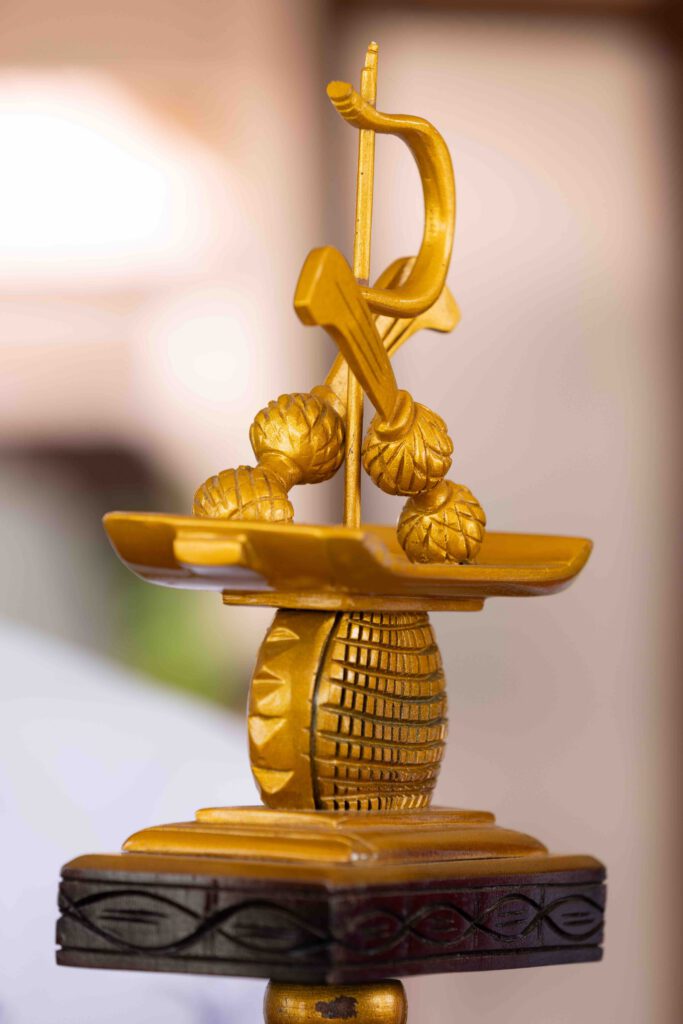
Reflecting classic Akan constitutional engineering, the state, known as the Ɛman, is strategically organised around the architecture of an army corps. In ceremonial assembly and defense, the sovereign moves encircled by his battle line: the Tsidomhen commanding the rear guard, the Ninfahen holding the right flank, the Benkumhen leading the left flank, the Tufohen directing the main body, and the Gyaasihen overseeing the interior royal household. On major ceremonial occasions, the procession advances in strict protocol. Royal palanquins carry the King and paramount chiefs, preceded by sub-chiefs on foot. At the head of the entire cortege march the Kyeamefo, state linguists who articulate the words of the rulers, bearing the carved family and royal staffs of office (ebusua poma and ahen poma), followed closely by the stool bearers carrying the consecrated stools of the state.
The Traditional Council Today
These institutional offices are not symbolic antiquities. They operate today as active customary governance alongside the contemporary municipal and national state. The Edina Traditional Council remains the custodian of ancestral law and stool lands. Through its Judicial Committee, it arbitrates chieftaincy jurisprudence, overseeing nominations, installations, destoolments, stool property settlements, and protocol between royal offices. Furthermore, the Council maintains the ritual calendar of the realm, celebrated most prominently during Edina Bakatue on the first Tuesday of July, when ceremonial offerings at the Benya lagoon formally inaugurate the coastal fishing season in a majestic assembly of chiefs, Asafo companies, and citizens. Collaborating with the local Municipal Assembly on municipal planning, resource stewardship, and community affairs, the Traditional Council ensures that ancestral governance is exercised dynamically in judicial settlement, territorial administration, and the annual life of the state.
Knowledge shared by Prof. Anthony Annan-Prah and Ebo Dadzie.
The Edinamanhen
-
Kwaa Amankwaa
1300 – 1355
Founder
-
Kweigya Ansa
1355 – 1390
-
Ampon Kuma
1390 – 1426
-
Ebo I
1426 – 1450
-
Kobina Amankwaa
1450 – 1475
-
Kwamena Ansa
1475 – 1510
The Portuguese emissary arrived in his reign. Referred to as Caramansa in Portuguese records
-
Kweigya Ansa II
1510 – 1545
-
Kofi Ahen
1545 – 1572
-
Eselfie Kondua
1572 – 1605
-
Nana Ntakudzi
1605 – 1660
-
Ampon Dzi-Edur
1660 – 1680
Said to have changed the succession from nephews to sons
-
Ohenba Ebu
1680 – 1720
The name alludes to that change in the line
-
Nana Anowie
1720 – 1760
-
Di Ewu I
1760 – 1820
Sixty years, the longest reign
-
Kobena Kondua I
1820 – 1868
He was destooled in 1868 for failing to handle the fante well
-
Nana Kobina Gyan I
1868 – 1873
Refused the oath of allegiance; deported to Sierra Leone by the British
-
Nana Kofi Ata
1873 – 1884
Regent
-
Nana Kweku Andoh
1884 – 1894
Regent; ceased to act on the King's return
-
Nana Kobina Gyan I
1894 – 1896
Restored after twenty one years in exile; died 12 March 1896
-
Kobina Konduah III
1896 – 1901
Destooled
-
Nana Kwesi Mensa
1904 to 1912
Destooled; a signatory to the Gold Coast petition to England
-
Barend Annan
1912 to 1915
Regent
-
Kodwo Kondua
1915 to 1918
Destooled
-
Kwesi Konduah
1918 – 1919
Regent; the state divided into factions
-
Nana Ntakudzi II
1920 to 1930
Regent
-
Kodwo Konduah
1931 to 1935
Re-installed by one faction
-
Ntakudzi II
1931 to 1935
Installed by the other faction
-
Di Ewu II
1936 to 1938
Installation confirmed by Government; Later abdicated the throne
-
Ntakudzi III
1939 to 1942
Destooled
-
Kweku Ewusi
1942 to 1945
Regent; Semew chief (Destooled)
-
Kobina Gyan II
1944
Ntakudzi II re-elected and installed under this name. Ruled for 3 days and died
-
Kodwo Konduah IV
1949 – 1979
-
Kodwo Nguandoh
1979 to 1988
Regent
-
Kofi Konduah V
1988 – 1993
-
Kwesi Tandoh
1993 – 1998
Regent
-
Nana Kodwo Conduah VI
1998 to the present
Dates before the nineteenth century are probable rather than exact. Where the museum's research differs from earlier printed accounts the museum's dates are given: the return of Nana Kobina Gyan I is recorded here as 1894, against the 1898 given in print, because he died in 1896. The years still marked for confirmation are being worked on with the Edina Traditional Council.
Image Archive


The Edinamanhen making spiritual connection before swearing in commences © Museum Elmina
Photographs © Museum Elmina. Reproduction or redistribution requires written permission.
Documentary
© Museum Elmina
Traditional Authority & Governance
Sources & Credits
Knowledge holders
-
Prof. Anthony Annan-Prah
-
Ebo Dadzie
How this knowledge was gathered
Oral history interviews recorded on video in Elmina, transcribed and curated by Museum Elmina for this page.
Recorded: August 2026, Elmina (on several days)
Curated by Museum Elmina