

Tangible Heritage
Nana Kobina Gyan I Square
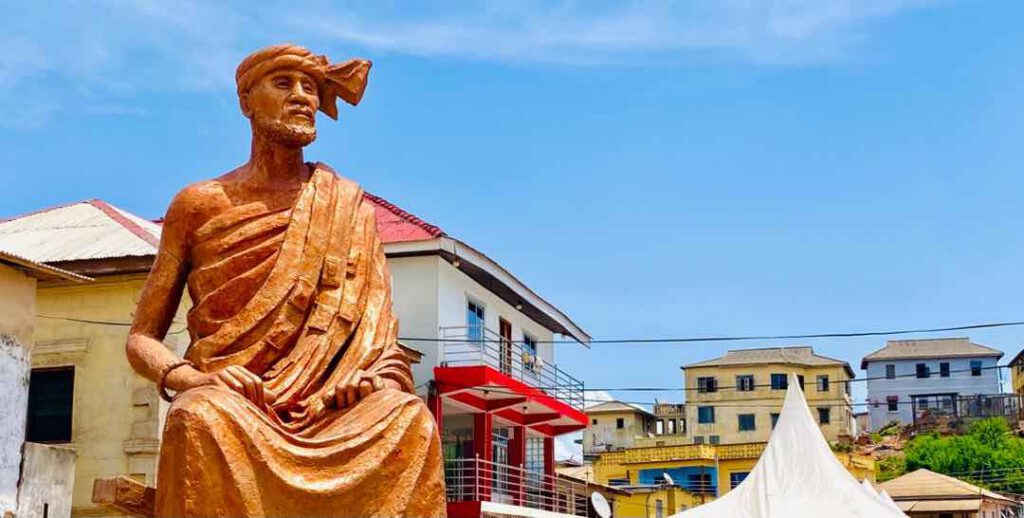
At the centre of Elmina stands a square that was once called Victoria Park. In 2005 it was renamed Nana Kobina Gyan Square, and in May of that year a bronze statue of the king was placed at its centre. The square honours Nana Kobina Gyan I, the King of Elmina who refused to accept British rule, and who was sent into exile and saw his town destroyed for that refusal.
The King Who Would Not Bow The King of Elmina refused British rule, and was sent into exile for it. His story, told as a comic.The King
Nana Kobina Gyan I was born in Elmina on 13 February 1821. His father, Nana Kobina Conduah I, was king from 1863 to 1869. During his father’s reign, Kobina Gyan was a prominent person and a leading voice for the people of Elmina. After his father was destooled in January 1869, Kobina Gyan became king on 15 July 1869.
One of his closest advisers was his Principal Secretary, Kweku Andoh (about 1836 to 1898). Andoh was a lieutenant in the British army, one of the first Africans to hold such a rank, and he later fought in the Sagrenti War. While the king was in exile, the British made Andoh the Regent of Elmina, a position he held until his death.
The Refusal
During Kobina Gyan’s reign, Britain was working to bring the whole southern Gold Coast under its control. On 6 April 1872, the Dutch handed over all their possessions on the Gold Coast, including Elmina Castle, to the British. The people of Elmina were angered by the handover, and anyone who supported it was treated as an enemy of the town. George Emil Eminsang, the lawyer who had arranged the transfer, was made commandant of Elmina Castle but soon had to flee to Cape Coast.
Kobina Gyan refused to fly the English flag he was given, and he refused to accept the British kostgeld, a rent that had long been tied to the castle. To test his loyalty, the British called the whole Elmina government to the castle at dawn on 12 March 1873 and demanded that the king sign a pledge of allegiance. He refused. As recorded by the Elmina District Commissioner, Hendrik Vroom, the king said:
The castle belonged to the Dutch government before, and the people of Elmina were freemen; they are no slaves to compel them to do anything … I refused the bribe because had I taken it, the chiefs would have turned round on me afterwards and said I sold the country for money.
Then he struck the table and said:
I am not afraid of your power. You may hang me if you like. I will not sign any paper.
Exile and the Bombardment
The king was arrested along with two other chiefs, Tando Mensa and Kwamina Ekum. They were put aboard a ship, the Seagull, held for a time at Cape Coast, and sent into exile in Sierra Leone without any trial. Kobina Gyan reached Sierra Leone on 30 April 1873.
A few weeks later, on Friday 13 June 1873, the British navy shelled and burned the old town of Elmina. This happened at the start of the Third Anglo-Ashanti War, known here as the Sagrenti War, after the British commander Sir Garnet Wolseley. Elmina was then a busy trading town of about 12,000 people. After the bombardment it was left a fishing village of around 5,000. The old town was cleared to make a parade ground, people were forbidden to rebuild there, and the families who returned settled on the other side of the Benya Lagoon.
In 1877 the British offered to let the king come home, but only as an ordinary citizen. He said no: he had been sent away as a king, and would return only as a king. With the help of Hendrik Vroom, he set foot in Elmina again on 17 May 1894 and was proclaimed king once more. He died on 12 March 1896, at the age of 75, and was buried in the Dutch Cemetery of Elmina. His exile had lasted twenty-one years.
Why the Square Matters
Nana Kobina Gyan I is remembered as a king who stood up for his people and for their freedom, and who paid a heavy price for it. The square at the heart of Elmina keeps his memory alive, and reminds every visitor of what the town endured in 1872 and 1873.
Documentary
© Museum Elmina